Enterprise AI Training & Talent Enablement
AI Navigator Academy
Help teams actually use AI, not just have heard of it.
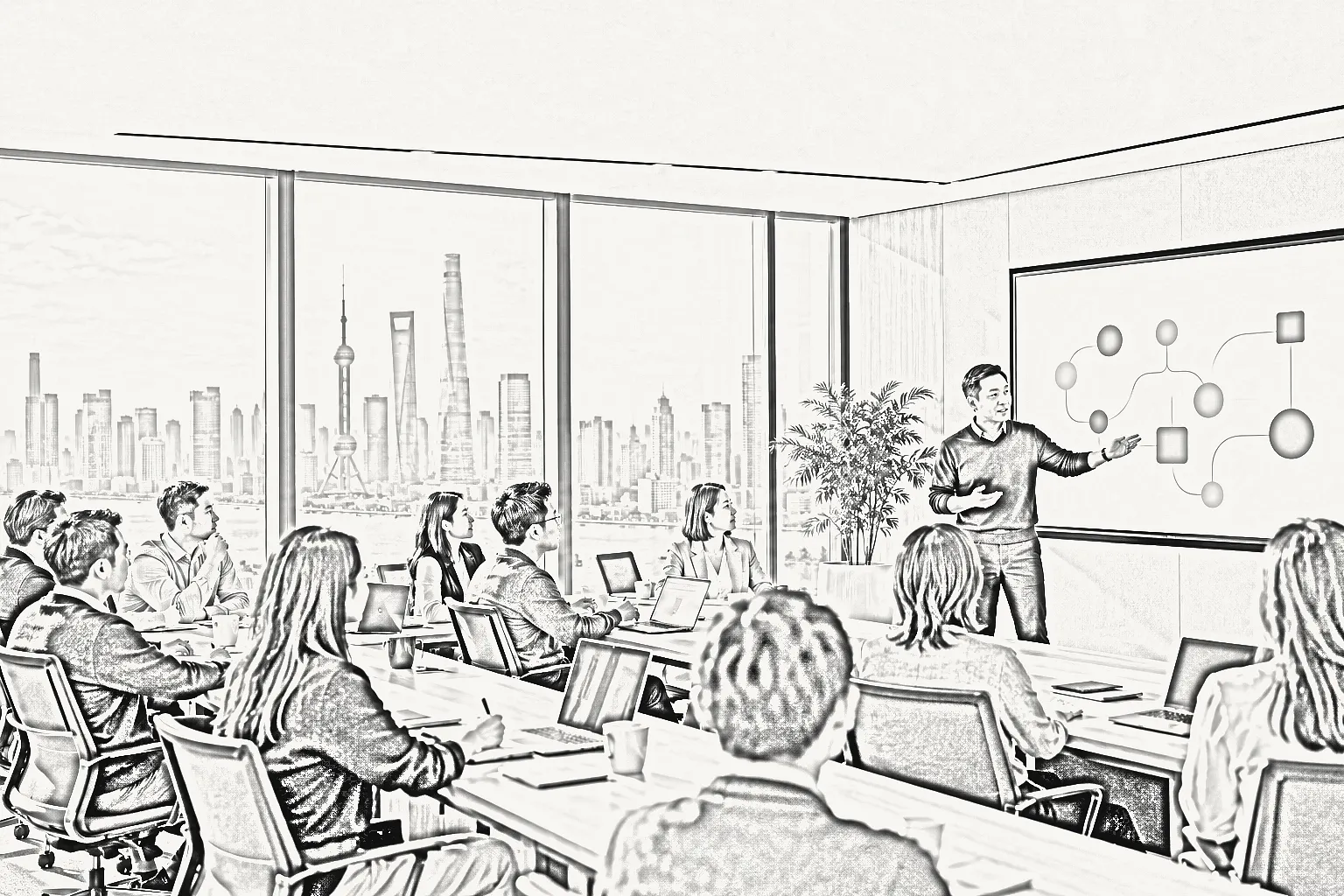
No vague trend lectures. We design courses by role, practice with your own business materials, leave behind prompt templates and workflows you can reuse right away, and then train in-house trainers to carry the methods forward.
- Format
- In-house training · open courses · annual coaching
- Best for
- Executives, business units, support functions
- Delivery
- On-site · live online · hybrid
- Billing
- Per session · per attendee · annual service
Who it's for · What it solves
Accounts bought, talks attended,
yet the team still can't use it.
The problem is usually not the tools, but that they are not tied to specific roles and tasks.
NowWhat you may be facing
- You've held a few AI talks, everyone was impressed, and then went back to their desks and the old way of working.
- A few people learned on their own and do well, but the know-how stays with them and the team can't copy it.
- Leadership wants to push AI but can't say which department or task type to start with.
- You worry staff paste client data and internal data into all sorts of AI tools.
AfterAfter the Academy
- Courses are designed by role, and practice uses your own real tasks and materials.
- Everyone takes away reusable prompt templates, and each department builds shared workflows.
- Leadership gets a department-ranked list of AI opportunities and a rollout pace.
- Courses include data security and usage rules, stating clearly what can and cannot be used.
Curriculum
From executives to front-line roles,
each learns what they can use.
Six course types can be run separately, or combined into a training plan around your company's goals.
Executive AI Strategy Workshop
Clarify what AI can and cannot do for the business, map each department's opportunities, and set the pilot scope and rollout pace.
Company-Wide AI Productivity
Everyday tasks such as writing, summarizing, spreadsheets, meeting notes and research, together with usage rules and data-security essentials.
Role-Specific Practice
Classes by role: sales, operations, customer service, design and engineering. Practice on that role's real tasks and produce role templates.
AIGC Content Creation Lab
Images, posters, short-video scripts and asset production, with attention to brand consistency, copyright and compliance review.
Agent-Building Lab
Turn repetitive processes into agents on a low-code platform: knowledge-base Q&A, form handling, report generation and other common cases.
In-House Trainer Development
Select internal leads and train them in topic selection, courseware and coaching methods, so AI skills keep passing on within the company.
Skills path
Four stages,
from understanding to rolling out across the company.
Each stage has clear goals and deliverables that can be checked and accepted. Hours shown are typical and adjusted to team size and goals.
-
01
Awareness
Know what AI can do and where its limits are, and find the tasks worth tackling first in your department.
-
02
Hands-on
Everyone can complete everyday writing, summarizing and analysis tasks on their own, and knows how to check the results.
-
03
Role Practice
Practice on the role's real tasks and turn scattered usage into a workflow the department shares.
-
04
Internal Rollout
In-house trainers take over teaching and Q&A, and the methods spread from the pilot department to more teams.
- Post-course satisfaction
- 0 / 5
- Average drop in practice-task time
- 0 %
- Still using it 30 days after completion
- 0 %
Demo data These figures illustrate how we evaluate and are not a promise of results; actual figures come from post-course surveys and project reviews.
Training process
Research before teaching,
and check afterwards that it's being used.
- STEP 01
Needs research
We interview your leads to learn team roles, current tools and the tasks you want to solve.
- STEP 02
Plan & schedule
We issue the course plan, timetable and practice-material list, and schedule once confirmed.
- STEP 03
Teaching & practice
Teaching mixed with practice; every module is practiced on a real task in class.
- STEP 04
Homework & assessment
Post-course assignments and a survey check that templates and workflows are usable.
- STEP 05
Follow-up review
A follow-up at an agreed time on how it is being used, with recommendations for the next stage.
Ways to work together
One session, a full in-house program,
or a year alongside your team.
Fees depend on hours, headcount, degree of customization and venue, and are set out in the quotation.
Open courses
For sending a few key people first to learn the methods before deciding on in-house training.
- Fixed topics, regular intakes
- Learn alongside attendees from other companies
- Courseware and practice templates after class
Dates and fees per the quotation.
In-house training
On-site or online, tailored to your industry, roles and business materials.
- Pre-course research and course customization
- Classes split by role, practice on real tasks
- Homework feedback and an assessment report
Quoted per session, per the quotation.
Annual coaching program
Training plus implementation support, for companies that want to roll out AI systematically.
- Phased courses covering all four stages
- Support for rolling out department workflows
- In-house trainer development and regular reviews
Quoted by annual scope of service, per the quotation.
FAQ
Before arranging training,
what people often ask.
Can complete beginners join?
Yes. The awareness and hands-on stages assume no prior experience and start from sign-up, basic operation and checking results. For role practice and agent building, we confirm attendees' background beforehand and add an introductory session if needed.
Online or on-site?
Either. Hands-on role training and workshops work best on-site, where we can coach during class. Teams in different locations can use live online sessions or a hybrid format.
Can it be tailored to our industry?
Yes, in-house training is customized by default. Before the course we research your roles and common tasks, and practice uses de-identified business materials you provide wherever possible, so what is learned in class can be used straight away.
Is there follow-up after training?
In-house training includes feedback on post-course homework and one follow-up at an agreed time. The annual coaching program follows up on implementation in phases throughout the year, with regular reviews. The exact follow-up follows the contract.
Do you issue certificates?
We can provide a certificate of completion, which is not a professional qualification. It records the content attended and hours, and does not represent any professional qualification or grade.
Other services
Once learned, how else to put it to work
Start with one conversation,
and get a course plan that fits your team.
Tell us your team size and the tasks you want to solve, and we will get back to you within working days (subject to the service agreement).